

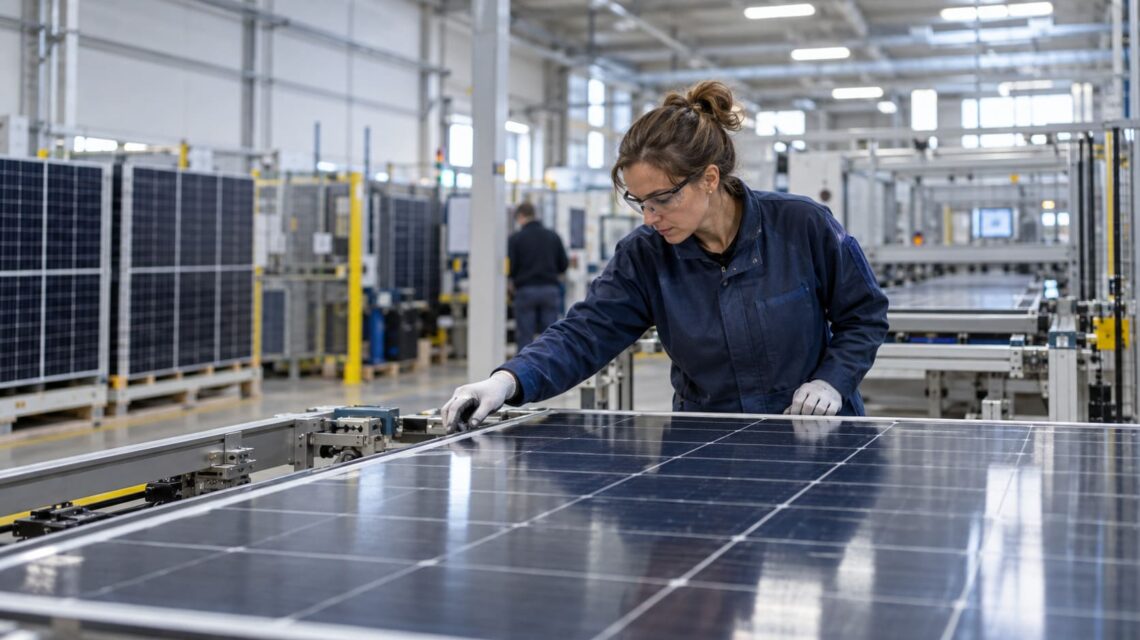

Laura Varo, Energy Efficiency Project Manager at Wattega, analyses the carbon footprint associated with manufacturing a solar PV panel and how the emissions balance varies depending on location and the electricity mix.
Amid the climate emergency, there is no question that a multisector transition to renewable energy is urgent and a priority. Moreover, this transition cannot be gradual. Political agendas need to devote more effort to reducing the carbon footprint, and we cannot wait, because we have already exceeded the 1.5°C threshold of climate anomaly relative to the pre-industrial era, with multiple and partly unpredictable effects.
In this context, the power generation industry, historically linked to the use of fossil fuels and therefore associated with a very significant greenhouse gas footprint (more than one fifth of global emissions, based on 2025 data), has found in renewables (solar, wind and hydropower) a way to generate energy with a zero carbon footprint if only generation per se is taken into account or, more accurately, a low-carbon footprint when a broader perspective is considered.
Beyond generation: emissions throughout the life cycle
In Catalonia, the Sectoral Territorial Plan for Wind and Photovoltaic Electricity Generation (PLATER) proposes a 100% renewable electricity system by 2050, with 14 GW of solar capacity installed on rooftops and built-up areas, 19,394.3 MW of ground-mounted solar, in addition to wind power (23 GW) and other renewables (5 MW). Beyond the controversy generated by the Plan regarding the location of installations and their environmental and landscape impact (occupying 383 km² of land, most of it non-degraded), there are aspects that the plan leaves aside, such as emissions over the full life cycle of new installations.
From the perspective of reducing CO₂eq emissions, the focus is placed solely on the generation stage, where renewables always come out ahead.
Has anyone asked what exactly is emitted when a solar PV panel is manufactured?
What is emitted in the production of a solar PV panel?
For some time now, a number of reports have emerged on this issue and, when reviewing the state of the art (including recent papers such as Low-carbon transition of China’s monocrystalline module and its global contributions (1) and Manuel Casal Lodeiro’s book Las verdades incómodas de la transición energética (2), among others), the conclusion is that the solar PV industry, as we understand it today, inevitably entails emissions for every panel manufactured.
According to (1), the production of a solar PV panel accounts for between 60% and 85% of its life-cycle emissions, due to the energy intensity of the process. This includes quartz mining to obtain silicon (the most widespread mineral on the planet, although it needs to be purified for solar energy production), chemical processes to obtain MG-Si (metallurgical-grade silicon), refining processes and encapsulation.
A review of the literature shows that emissions from the production of a solar PV panel in China, currently the world’s largest producer, amounted to between 0.31 and 0.39 kg CO₂eq/Wp in 2023.
Therefore, for a 400 W panel, 140 kg CO₂eq are emitted (0.35 kg CO₂eq/Wp). Emissions from transport, installation and waste management must also be added, but leaving these aside, let us consider whether or not these emissions are offset over the panel’s service life.
The Barcelona case: manufacturing emissions and avoided emissions
A 400 W panel in Barcelona will generate around 1,500 kWh/kWp·year, meaning that over a 20-year service life it will have generated around 12 MWh.
Using the emission factor of the Spanish electricity mix (283 gCO₂eq/kWh), this would result in avoided emissions of up to 3,400 kg CO₂eq, far above the 140 kg CO₂eq associated with each panel. Therefore, although the solar PV industry has associated emissions, they are not high enough to outweigh the emissions that would otherwise be produced over 20 years in Spain.
The Norway case: what happens with an almost 100% renewable electricity mix?
Let us carry out the same exercise for Norway, which has an almost 100% renewable electricity mix and an emission factor of between 5 and 18 gCO₂eq/kWh. Taking 12 gCO₂eq/kWh as the midpoint and assuming a specific yield three times lower than in Catalonia, the emissions avoided over 20 years amount to 46 kg (three times lower than the initial emissions). In this case, the emissions associated with manufacturing a single solar PV panel are not offset by the emissions avoided by not drawing electricity from the Norwegian grid. So, what is the critical value? It depends on location because of the specific yield, but in Catalonia it would be these 10 gCO₂eq/kWh.
This leads us to consider that a panel manufactured in China (with its current electricity mix) and installed in Norway is currently unsustainable, and that as global electricity mixes become increasingly renewable, the same situation may eventually arise elsewhere. But what emissions were associated with building Norway’s hydroelectric dams or offshore wind turbines? These are difficult questions to answer, but in any case these infrastructures now make it possible to generate electricity without emissions during the generation process. Nevertheless, what is clear is that, when the emissions from producing a solar panel are analysed from cradle to gate, specifically up to the factory gate, at present they are not offset by the generation emissions of a system based almost entirely on renewables. This is unsurprising, since the generation emissions of such a system are practically zero and the comparison does not include the embodied emissions associated with deploying large renewable installations, such as hydroelectric facilities.
In any case, if a system based on fossil fuels (rather than electricity) is electrified, photovoltaics always offsets the emissions (the emission factor for natural gas is 0.202 kg CO₂eq/kWh, and it is even higher for coal or diesel).
The energy transition also requires reducing demand
Does this mean, however, that panels should not be used for this transition in electricity systems that are almost 100% renewable? I believe that, as electricity systems become more renewable, we will also need to question, minimise and reduce energy use in order to limit the need for new infrastructure with embodied emissions. It would also be advisable to start doing so now, because the best kWh is the one that is not consumed. We should also remember that the emissions associated with recycling the panel and managing its materials once it can no longer be used must be added to the total.
Now that the literature shows that manufacturing a panel in China does not generate more emissions than the amount that would be avoided over 20 years thanks to solar power generation (in the case of Spain), will we be able to deploy new installations at the pace demanded by the climate emergency? Will degraded areas be prioritised over fields or protected areas? Will we contain energy demand in a society moving towards indefinite growth while disregarding physical limits?
